


At Recente Studio, the mask holds a central place.
Not as theatrical makeup, but as a tool for revelation. We use it in reverse: our mask does not hide, it UNVEILS.
Minimal and almost bare in its simplicity, it becomes a device that shifts the viewer’s attention. The spotlight, to borrow a theatrical expression, moves directly onto the garments. That is our intention: to turn the wearer into a NEUTRAL presence, without gender, without age, without time. A reminder that garments can exist as autonomous beings, capable of telling their own stories and of being worn by anyone who chooses to enter their path.
This enigmatic object has accompanied humanity through crucial moments. From ritual accessory to instrument of metamorphosis in ancient theatrical performances, it has always served a clear purpose: transferring symbolic power from the actor to the audience, transforming the viewer into an active interpreter of the image. In this powerful symbol, the boundary between what is hidden and what is revealed dissolves.
Fashion has long played with masks, lifting them from their original contexts and transforming them into communicative tools. Thanks to their strong visual impact, they became central to the creative universe of Martin Margiela. He belongs to that bubble of visionaries who drifted through time propelled by impulses that rewrote the parameters of fashion history. His work in deconstruction, the reuse of fabrics, and his anti-fashion stance challenged mass culture and the marketing strategies of major maisons, shaping him into a global icon.
From the SS 1989 debut onward, the masks—already sources of inspiration for artists like Picasso and Magritte—stepped into the runway to stay. René Magritte once wrote: “An object may suggest that there are other objects behind it.”

Maison Martin Margiela, Street Special Edition Book 1 & 2 1989 - 1999
This idea of hiding and anonymising transfers perfectly into Margiela’s world: the vanishing point shifts to the clothes, not to the people wearing them. “Look at my clothes and only judge my clothes.” The models become faceless presences, anonymous from the very beginning of the line. What started as a budget constraint, since the house could not afford famous models, soon turned into a poetic and conceptual declaration. A visual manifesto aligned with the anti-establishment spirit that still defines the maison: moving against what already exists.
Masks continue to fascinate for their dual power, their ability to reveal while concealing. They have inspired other visionaries as Alexander McQueen, Rick Owens, Vetements, Junya Watanabe, Rei Kawakubo. In the work of the Japanese designers, it is impossible not to recall their long collaboration with Katsura Kamo, the artist of faces.
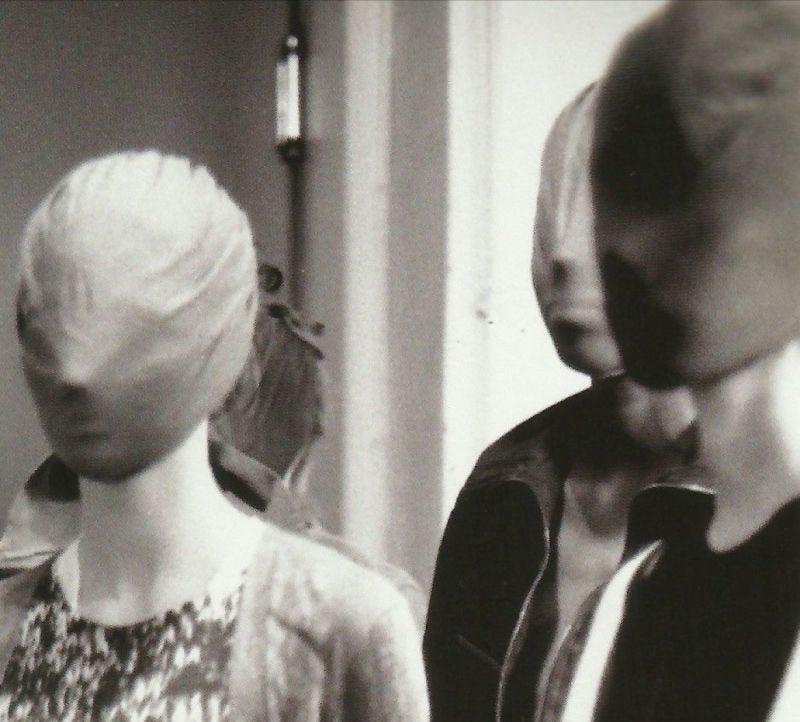
In our creative studio, when the face steps back, the GARMENT and its identity step forward as the true PROTAGONIST. Attention shifts toward gestures and movement: other forms of language, other narrative possibilities. Leaving behind the traditional fashion image, where models become recognizable aesthetic references, is a necessary choice for us.
We want the garment to be the first interlocutor, the true subject of the conversation. We want pieces to stand as autonomous individuals, capable of telling their stories regardless of who wears them. Our garments have lives of their own, and memories woven into their threads. Clothes are not only material; they are essence, character, detail, narrative.
So is it possible to reveal by concealing? For us, the answer is yes. Our focus on this mysterious object lives in the balance between ABSENCE and ESSENCE. The mask does not hide the person. It reveals the garment.
Because fashion, for us, is not about identity. It is about meaning, memory, and presence.
When we curate, when we style, when we shoot, we ask ourselves: ‘What is the garment saying?’
Sometimes, the silence of a masked face speaks louder than any expression.
